The $900 Snow Blower Dilemma: What Does Winter Really Cost Homeowners?
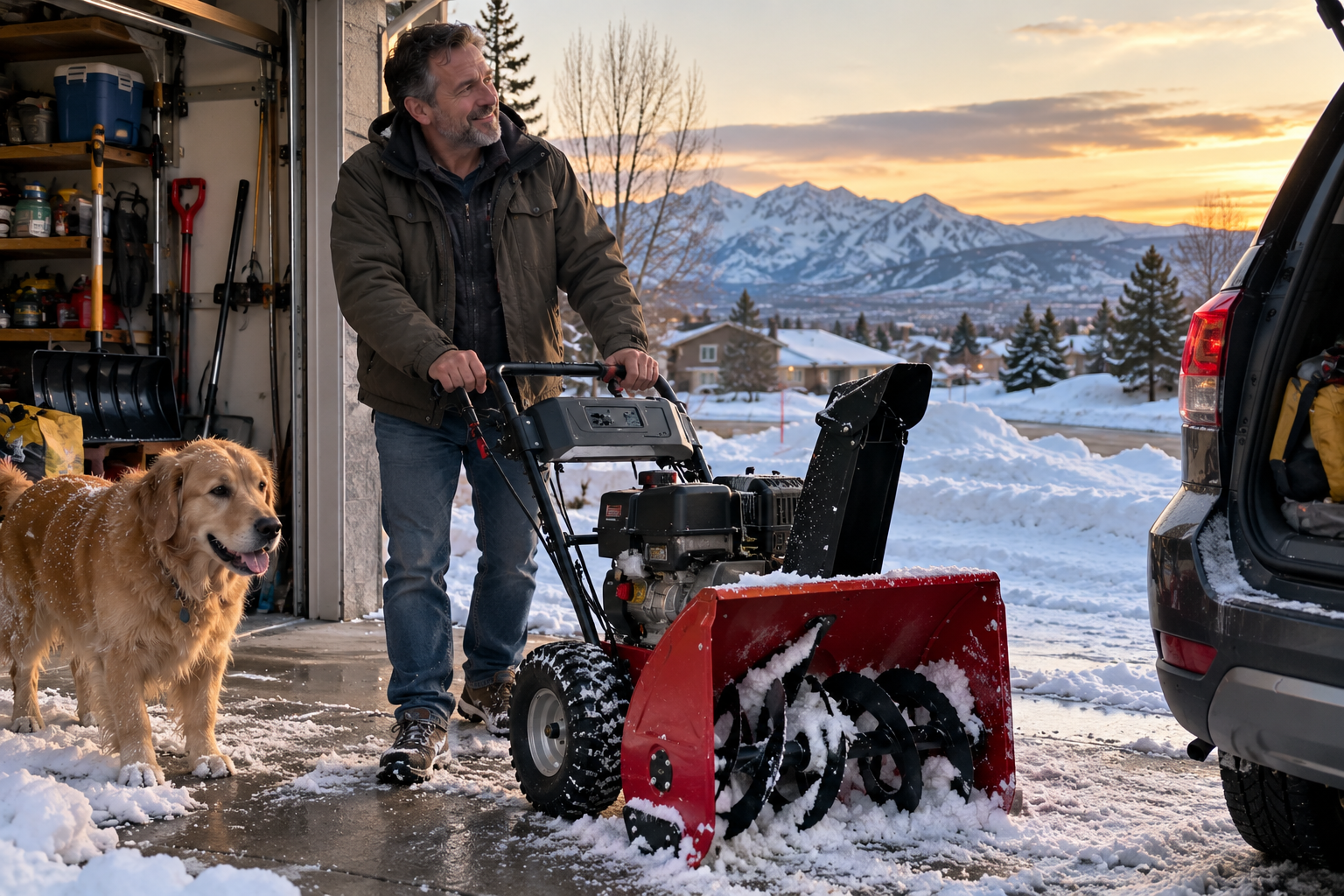
John, a homeowner from Reno, Nevada, had a problem with a snow blower. Not a mechanical problem. He didn't even own one yet. His problem was the price.
“Nine hundred dollars! For a machine I'm going to use a few times a year and spend the other 350 days trying to park around in the garage.”
He'd spotted a $900 snow blower at Costco. Was it sensible preparation or just another expensive garage decoration? That question sent our fictional homeowner down a winter-shopping rabbit hole: ice melt, firewood, frozen pipes, tires, batteries, and even dog paws.
Here's what came out of John's winter-preparation conversation.
1. The $900 Snow Blower Debate
John's first argument was fair: why spend $900 when a shovel costs around $30? A shovel works fine for small areas and occasional light snow, although heavy shoveling is strenuous work. Battery-powered machines are quieter and generally need less routine maintenance than gas models, but runtime drops when snow gets deep and wet. Two-stage gas models are better suited to long driveways and heavy snowfall.
Here's the math. Keep a $900 machine for eight winters and use it 15 times each year: that's $7.50 per use before maintenance and operating costs. Use it twice a year and it's $56.25 per use. Hiring someone might be cheaper—assuming you can find someone available when the storm arrives.
John wasn't ready to decide. Yet.
What If Everyone Needs a Contractor at Once?
Hiring a crew sounds easy until a storm hits and everyone on the block starts calling the same companies. Regular customers may already have service slots. During the extraordinary 2021 Texas winter storm, a University of Houston survey reported that 29% of respondents had trouble finding a plumber or another service professional. That is not a prediction for Reno, but it shows how quickly help can become scarce when demand spikes.
John could book seasonal snow removal in advance and ask about response times, trigger depths, priority, and the ridge left by street plows. Or he could own the equipment. Neither option guarantees a clear driveway at 7 a.m., but waiting until the first storm to make the decision is the riskiest plan.
The Safety Calculation
There is another reason not to make this decision on price alone. The American Heart Association warns that heavy snow shoveling can trigger cardiac events in susceptible people. Cold weather and sudden exertion are a rough combination. For some homeowners, paying for help or using appropriate powered equipment is a safety decision, not a luxury.
2. How Did Buying Salt Become So Complicated?
John expected to buy a bag of salt. Instead he found rock salt, calcium chloride, magnesium chloride, pet-friendly blends, and products that promised to protect everything except, apparently, the ice.
Rock salt is usually inexpensive but works less effectively in severe cold. Calcium chloride and magnesium chloride can perform at lower temperatures, though they cost more and can still affect concrete, metal, and plants. Sand doesn't melt ice; it adds traction.
The cheapest bag isn't always the cheapest solution if overuse contributes to damage. And 'pet-friendly' isn't a guarantee of safety. Read the label, follow application rates, and choose for your surface and conditions—not for the smiling dog on the packaging.
Ask About the Driveway, Not Just the Temperature
New concrete, decorative paving, natural stone, and asphalt do not respond identically to deicers. Freeze-thaw cycles, excess chemical use, and surface condition all matter. If the driveway is new or already deteriorating, John should check the paving manufacturer's guidance before spreading anything. The cheapest bag of salt is not a bargain if it contributes to an expensive repair.
3. Firewood: The Business of Selling Trees by Mysterious Measurements
One seller offered John a truckload. Another offered a cord. Someone else mentioned a face cord. John wondered why buying chopped-up trees required a new measurement system.
A full cord is 128 cubic feet of stacked wood, traditionally 4 × 4 × 8 feet. 'Truckload' tells you very little unless the seller states the volume. Ask about quantity, delivery, stacking, and moisture.
Dryness matters more than the usual oak-versus-pine argument. Properly seasoned firewood generally has 20% moisture or less. Wet wood burns poorly and can contribute to creosote buildup. Store wood off the ground and protected from moisture, and check local wood-burning restrictions.
Can You Actually Test “Seasoned” Firewood?
Yes. The U.S. Environmental Protection Agency recommends burning wood with a moisture content of 20% or less. Split a log and check the freshly exposed interior with a suitable moisture meter. A dry exterior does not prove the center is dry. John liked the idea of testing a seller's claim rather than arguing about what “seasoned” means. Apparently buying firewood now involves scientific instruments.
4. The Outdoor Water Connections Nobody Remembers
John had arranged sprinkler winterization and thought he was finished. Then he noticed the hose still attached to the faucet. And the outdoor kitchen sink. And a line serving the yard.
Check garden hoses, outdoor kitchens, fountains, showers, greenhouses, detached buildings, and automatic pet watering systems. Each may have its own valves, pumps, or exposed supply lines. A heated pet bowl won't necessarily stop the pipe feeding it from freezing.
Walk around the property and identify everything connected to water. Follow equipment-specific winterization instructions; ask a professional when a system is complicated.
The Cost of Getting It Wrong
Insurance Information Institute data put the average homeowners insurance claim for water damage and freezing at approximately $15,400 for 2019–2023. That figure covers multiple kinds of water damage, not just frozen pipes, and it does not mean a forgotten hose will cause a five-figure loss. Still, it makes ten minutes spent checking outdoor faucets seem worthwhile. A hose left connected to some frost-proof faucets can prevent proper drainage.
5. John's AWD Car Isn't a Snowmobile
John felt pretty confident about his all-wheel-drive vehicle until tires came up. AWD helps with acceleration, but it doesn't magically improve braking on ice. Tires, tread, and traction devices still matter, especially on mountain roads.
Keep a snow brush, ice scraper, winter-rated washer fluid, gloves, blanket, flashlight, charger, compact shovel, and basic emergency supplies in the car. Check current chain-control rules before driving toward Lake Tahoe.
A bottle of winter washer fluid isn't glamorous. Neither is realizing your washer fluid has frozen while a truck sprays dirty slush across your windshield.
6. The Battery Problem Nobody Mentions at the Store
John liked cordless equipment: no gasoline and fewer engine headaches. Then he learned that some lithium-ion batteries cannot be charged safely when they're too cold. Check the manufacturer's charging and storage temperatures before the storm.
Portable power stations are handy for phones, lights, and small electronics, but their capacity is finite. Don't assume a compact battery can run an electric heater all night. Check the wattage and expected runtime first.
7. Where Does All the Snow Go?
Suppose John clears the driveway in record time. Wonderful. Now he has a giant pile beside the garage and another one blocking drainage. A snow blower doesn't eliminate snow. It relocates it.
Plan where snow can accumulate without blocking doors, hydrants, visibility, drainage, or outdoor HVAC equipment. Keep it away from foundations and think about where meltwater will flow and refreeze.
If you hire a contractor, ask whether they'll remove the ridge left by street plows—and where they'll put the snow. A clear driveway with a blocked garage isn't much of a victory.
8. The Dog Has a Different Opinion of Winter
John's dog considers snow free entertainment. Ice melt and frozen drinking water are less entertaining. Deicers can irritate paws; snow can pack between paw pads; and antifreeze is extremely toxic to animals.
Keep a towel near the entrance, clean paws after walks, check outdoor water, and store chemicals securely. Add pet food and essential medications to your storm supplies.
9. The Winter Supply Station
John owned several pairs of gloves. Finding two that matched was the challenge. The shovel was behind the mower, the flashlight upstairs, and the ice melt possibly buried under holiday decorations.
Keep the shovel, gloves, scraper, and sealed ice melt in one accessible spot. Store snow blower accessories nearby. Inside, keep lights, power banks, blankets, and emergency supplies where people can actually find them. No elaborate system required.
10. What Does All This Cost?
Illustrative U.S. planning ranges: shovel $20–$60; snow blower $250–$2,000+; ice melt $15–$50; firewood $100–$500+; scraper and brush $15–$40; emergency supplies $30–$100; flashlights or power banks $20–$100. These aren't verified current local prices, and firewood costs depend heavily on quantity.
The good news: most of this equipment doesn't need replacing every year. Before shopping, check what you own and what you actually use. Panic-buying during the first storm is rarely a great way to compare options.
John's Winter Checklist
- Inspect snow shovels and snow blower
- Buy appropriate ice melt or sand
- Order properly seasoned firewood
- Winterize outdoor water connections
- Check tires and traction equipment
- Prepare a car emergency kit
- Charge batteries and power banks
- Plan where removed snow will go
- Arrange snow removal if needed
- Prepare pet supplies
- Organize winter equipment
So, Did John Buy the $900 Snow Blower?
He did. At Costco. For $900.
His reasoning was simple: he'd rather have it ready than wait for a snow removal contractor during a major storm. Of course, now he's hoping for enough snow to justify the purchase. You spend all that money preparing for bad weather, then feel slightly cheated when the weather is nice.
At least he's ready. And if the snow doesn't come, he's got an impressive new garage decoration.
There's no universal answer. A homeowner in Reno may need very different equipment from someone living higher near Lake Tahoe. Track what you buy, what works, and which professionals you hire. Profylist is being built to help homeowners organize maintenance, projects, expenses, and contractor information—so next winter's decisions are easier.
This is Part 2 of the winter home preparation series. Part 1 covers roofs, gutters, heating, insulation, and plumbing.
Research and Further Reading
- Insurance Information Institute, homeowners insurance water damage and freezing statistics: https://www.iii.org/fact-statistic/facts-statistics-homeowners-and-renters-insurance
- Texas Comptroller, 2021 winter storm impact and University of Houston survey: https://comptroller.texas.gov/economy/fiscal-notes/archive/2021/oct/winter-storm-impact.php
- U.S. Environmental Protection Agency, Burn Wise: https://www.epa.gov/burnwise
- American Heart Association, cold weather and snow-shoveling safety: https://www.heart.org
Editor's note: John is a fictionalized homeowner character. His conversation and Costco purchase are illustrative, not a reported interview or verified transaction.
Connect with local contractors. Your contact info stays private until you choose.