Can You Guess When This House Was Renovated?
Four kitchens. Four decades. And one expensive lesson about American home design.
Here's something weird about American houses. You can walk into a home you've never seen before, take one look at the kitchen, and somehow know when it was remodeled. Nobody tells you the year. You don't check the permits. You just look around and think: Yep. That's 2005. How the hell does that happen?
And why can a house built in 1911 still look incredible, while a kitchen remodeled in 2018 already feels outdated? Let's play a little game.
The Renovation Detective Challenge
Look at the four kitchens below. Don’t read the answers yet. Can you guess which decade each kitchen represents? These are illustrative design examples, not properties with verified renovation dates.
Write down your guesses: A ___ B ___ C ___ D ___
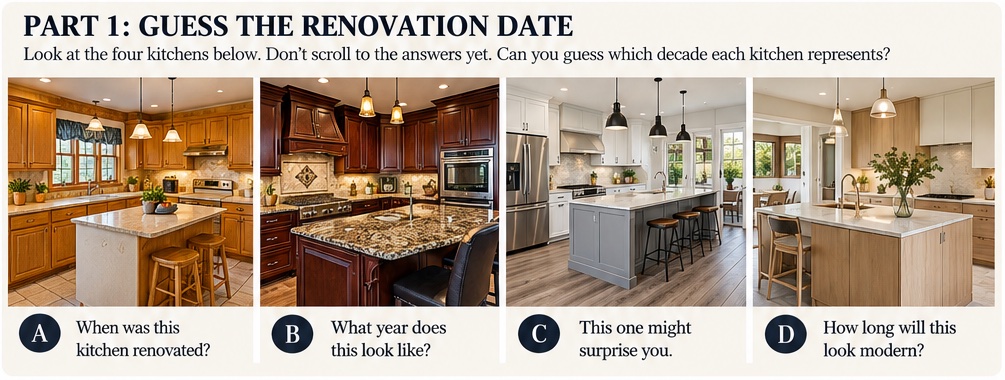
House A: The 1990s — The Honey Oak Kingdom
Oh, the oak. The golden, orange, shiny oak. Oak cabinets. Oak trim. Oak everywhere. People loved it: solid, practical, familiar. But the combination of honey-colored stain, beige countertops, brass hardware and decorative borders now carries a timestamp. The oak itself wasn't necessarily a mistake. Natural oak remains popular today. It's the specific combination that reveals the era.
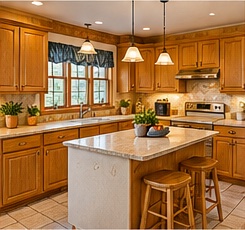
House B: The 2000s — Welcome to the Granite Palace
Remember when granite countertops meant you'd made it? Dark cherry cabinets, busy granite, travertine backsplash, oil-rubbed bronze fixtures. Some of these kitchens cost a fortune and still function perfectly. What changed wasn't the durability of stone or wood. It was our collective idea of what luxury should look like. That's worth considering before spending $50,000 on your own kitchen.
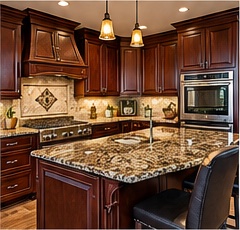
House C: The 2010s — The Great Gray Takeover
Gray floors. Gray walls. White Shaker cabinets. Black hardware. Perhaps a farmhouse sink or barn door. It was meant to look clean and modern. But when millions of homes adopt the same look, that look becomes a timestamp. Gray wood-look flooring can suggest a late-2010s remodel, although it never proves the date.
House D: The 2020s — The New Timeless?
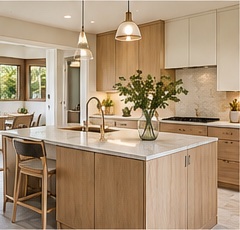
Natural white oak. Warm cream walls. Subtle stone. Soft lighting. Everything feels calm, organic, expensive. But didn't people say timeless about gray kitchens? The exact combination of pale oak, fluted details and curved islands might eventually become as recognizable as cherry cabinets and speckled granite. We simply don't know yet.
Why Does a 100-Year-Old House Sometimes Look Better?
A well-preserved Craftsman home can have solid wood doors, hardwood floors, built-ins and a stone fireplace that still feel coherent today. Its details belong to the architecture. That doesn't mean every old home is beautiful or every new home is trendy. It means architectural consistency often ages better than a collection of fashionable finishes.
Four Approaches That Can Age Gracefully
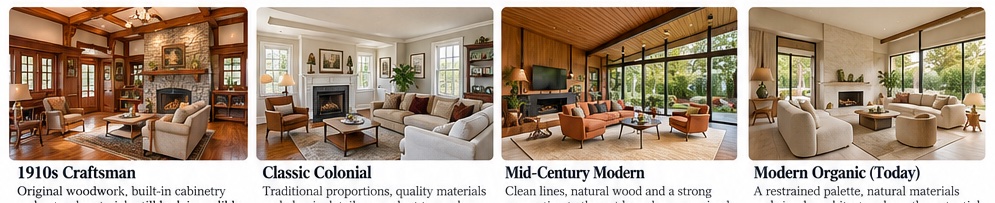
Craftsman • Colonial • Mid-Century Modern • Modern Organic. These are conceptual illustrations, not documented historic interiors.
How to Investigate Your Own House
Start with visual clues: cabinets, countertops, backsplash, floors and fixtures. But remember that rooms are often renovated at different times. A 2005 kitchen can sit beside a 2019 bathroom and plumbing from 1974. For more reliable dates, check local building permits, previous listing photos, contractor invoices, warranties and product labels. Cosmetic work may never appear in permit records.
The $50,000 Question
Imagine renovating your kitchen today. Before choosing a highly distinctive, expensive finish, ask: If this goes out of style in seven years, how much will it cost to change? Paint and hardware are comparatively easy. Custom cabinetry and tile are not. Spend money on what needs to last; have fun with what is easy to replace.
One Last Question
Think about the kitchen in your own house. Can you guess when it was renovated? And if someone walks into it in 2046, will they instantly recognize the decade—or simply think it's beautiful? Which kitchen would you choose today: A, B, C or D?
At Profylist, we believe homeowners deserve better information before making expensive decisions—from comparing contractors to preserving renovation records, materials, costs and warranties.
Image note: All illustrations in this document are AI-generated examples of styles, not photographs of actual dated renovations.
Connect with local contractors. Your contact info stays private until you choose.